Content
You are here: Programs & Courses » Master's Programs » Mannheim Master in Sustainable Business & Technology (Part-Time) » Content
Master Transformation Tools Step by Step
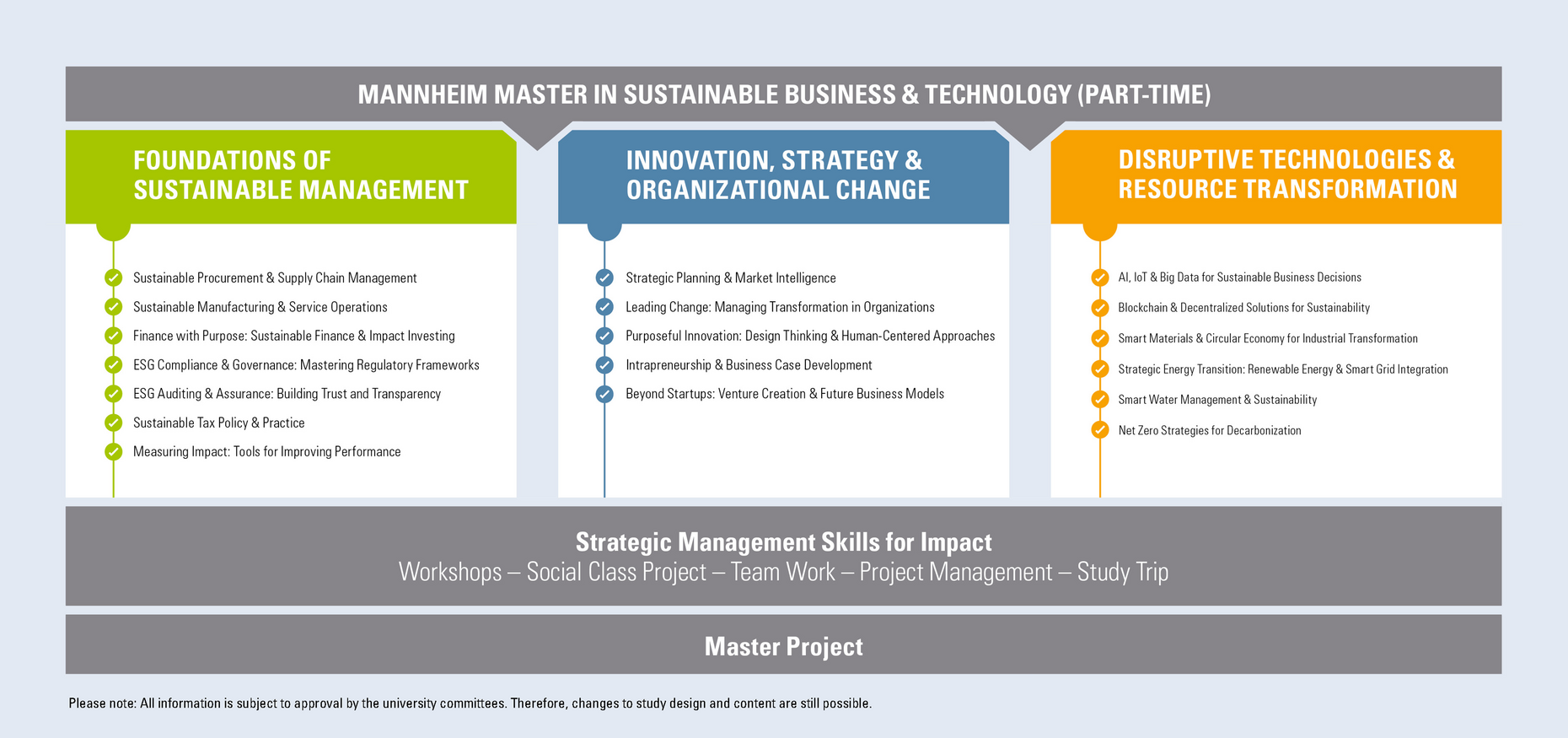
Across three pillars – Foundations of Sustainable Business, Innovation, Strategy & Organizational Change, and Disruptive Technologies & Resource Transformation – you will learn how to analyze markets and regulations, design convincing strategies, and translate them into concrete initiatives. Project management modules, personal development workshops, a study trip, and a real-world Business Master Project give you the chance to apply these tools in practice, work with data and new technologies, and lead cross-functional projects that reshape business models and value chains.
Lecturers' Perspectives

Prof. Dr. Monika Schuhmacher, Professor for Business Administration with the focus on Technology, Innovation and Start-up Management, MBS Adjunct Faculty“Technologies such as AI or digital ecosystems are fundamentally reshaping what, how, and for whom value is created. We need scalable, future-ready, and sustainability-driven business models. In my teaching, I connect cutting-edge research with real-world business challenges to explore different forms of venture creation and long-term value creation.
Participants gain the leadership skills that define the future – systemic thinking, technological literacy, and strategic insight into sustainability as a driver of innovation and competitiveness. The program empowers professionals not just to adapt to change, but to actively shape the future of business.”

Prof. Dr. Alexander Hahn, Professor of Emotional Artifical Intelligence and User Experience Research, MBS Adjunct Faculty“I teach in the field of Sustainable Business and Technology because the success of sustainable organizations depends on a deep understanding of user needs, technological feasibility, and robust business models. This is the perspective I want to share with our ambitious participants. It enables them to develop cutting-edge business models and shape them responsibly – in the best interests of users and society.”
An Overview of the Program Structure
The Mannheim Master in Sustainable Business & Technology is organized in modules that build on each other over a period of 24 months. This allows you to retain full-time employment throughout the program and apply your newly acquired knowledge directly at your workplace. (Click to enlarge the chart)
The program will only take place if a minimum of 20 participants is reached.
Together with a team of fellow students, you will apply the specialist knowledge and methodologies acquired throughout your studies in a comprehensive practical project, either finding a solution to a business challenge at one of our partner companies or creating a business plan for a new product or company.
Teamwork in essential program elements, such as the Master Project, and soft skills courses foster the consolidation of the necessary key qualities for management positions.
The Social Class Project provides a meaningful project management challenge while also giving students the opportunity to make a difference in the community.
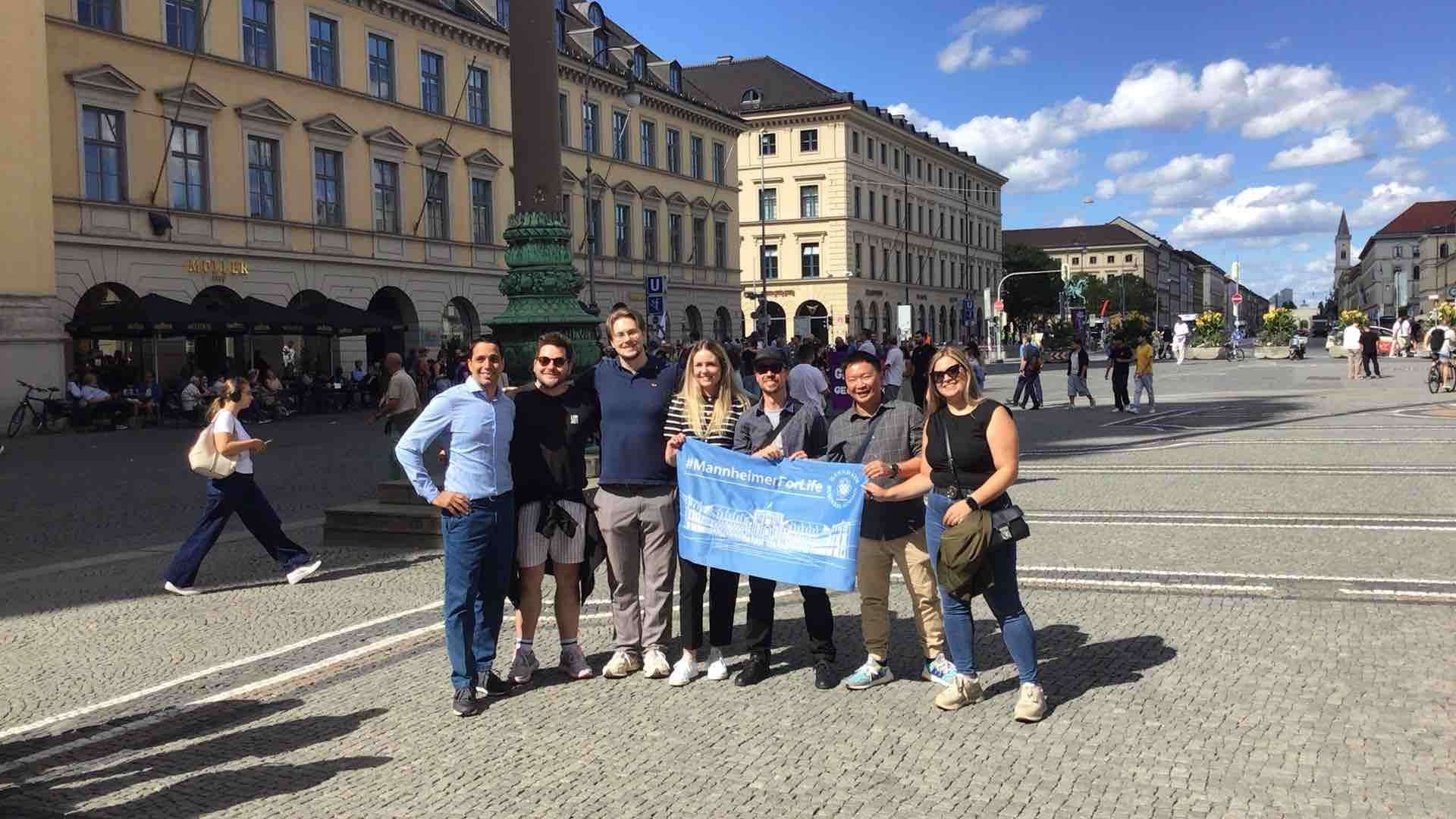
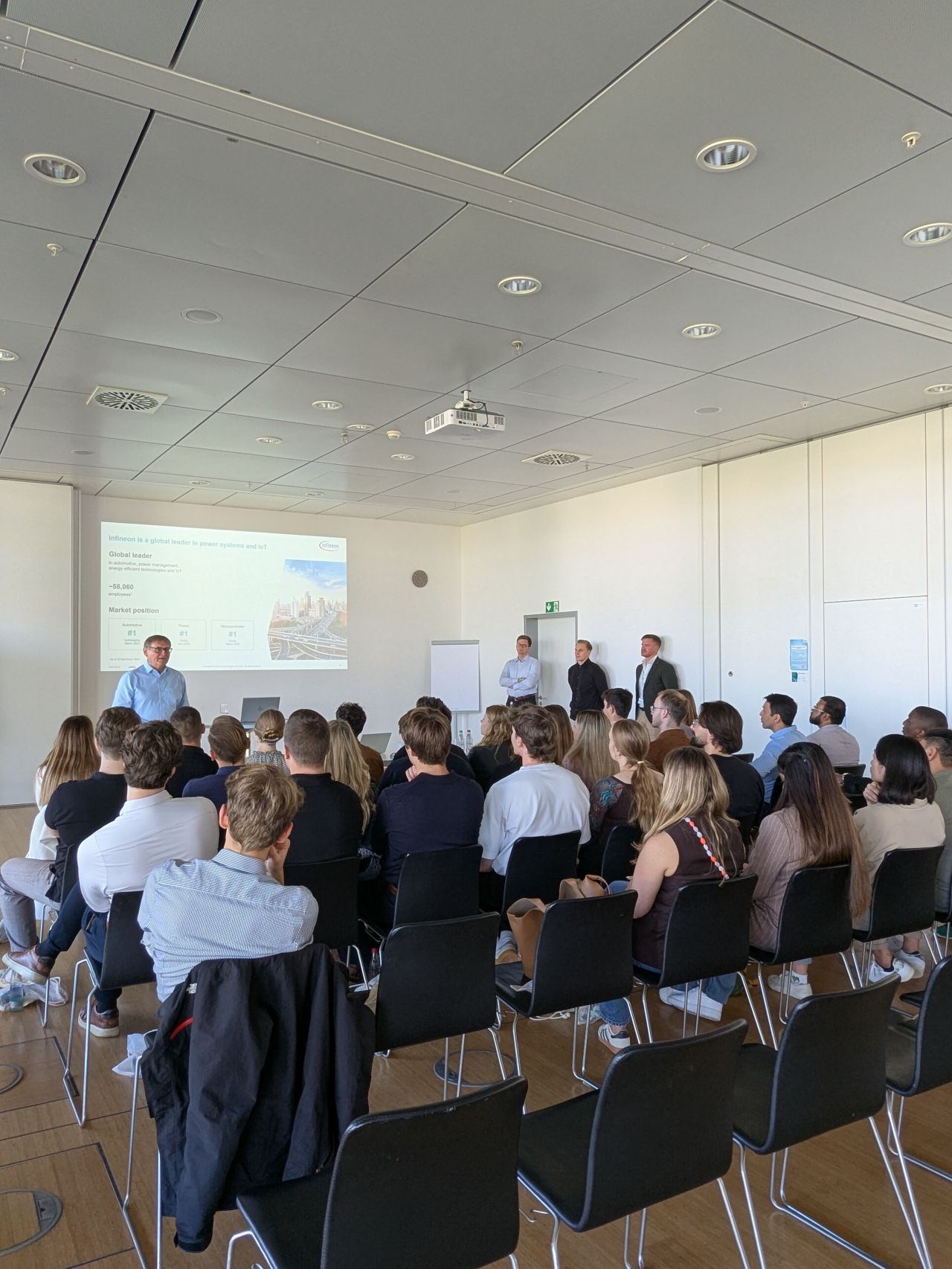
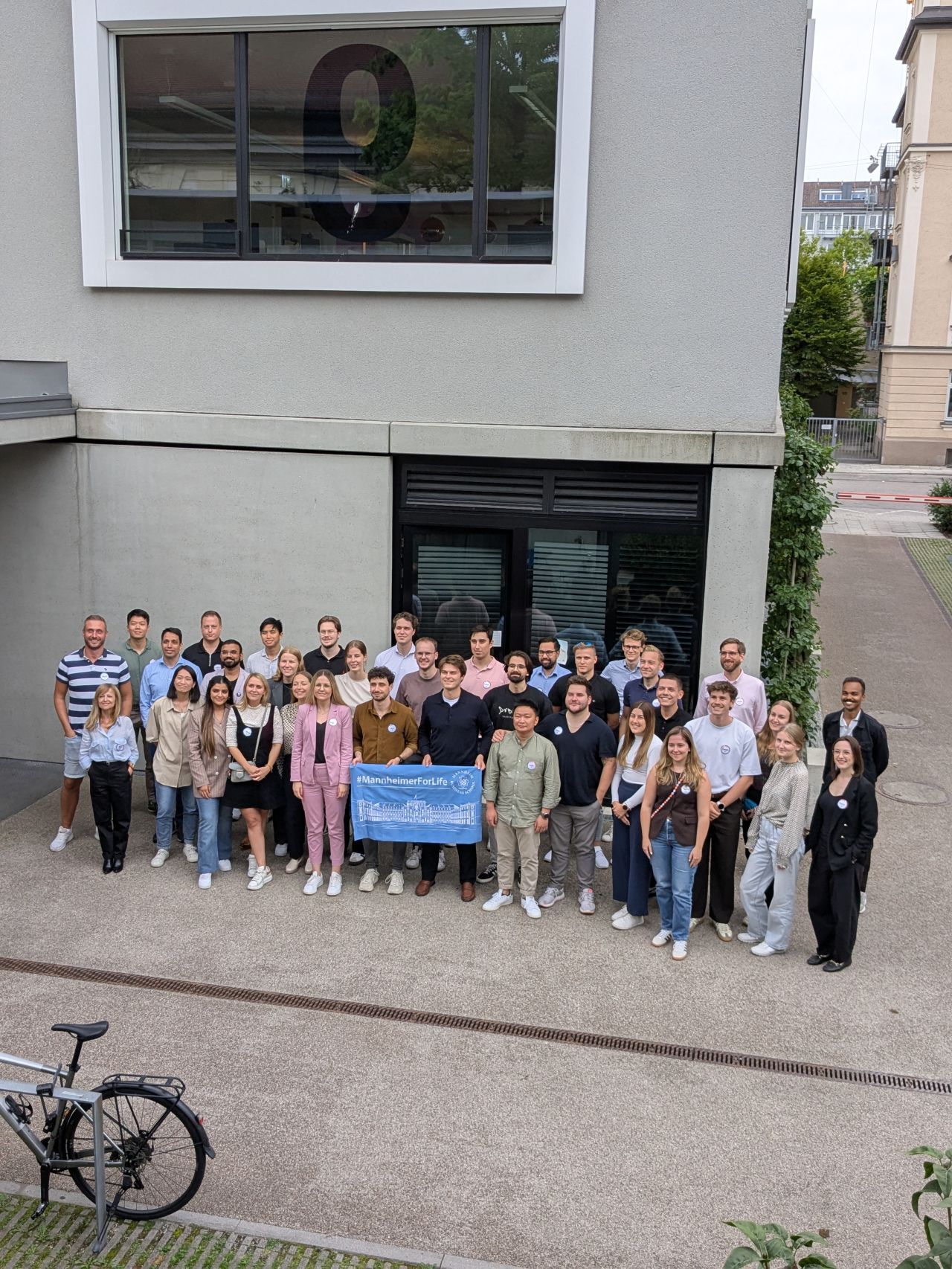
A study trip with your peers is an opportunity to broaden your horizons and learn from visiting a business school located in a European business hub, where you will attend a mandatory course (accommodation included). Take a look at impressions form previous trips below.
Impressions From Previous Study Trips
Foundations of Sustainable Management
This course introduces participants to sustainable supply chain management, emphasizing responsible procurement practices, logistics optimization, and efficient supply chain coordination.
Participants will learn strategies for minimizing environmental impact while maximizing efficiency, including ethical sourcing, reducing carbon footprints, and enhancing supply chain resilience. In particular participants will learn how to evaluate and implement responsible sourcing practices, optimize logistics to reduce environmental impact, and align supply networks with global sustainability regulations.
Through practical tools and real-world cases, the course enables students to manage complex supply chains effectively while global challenges and regulatory requirements.
Learning Objectives:
- Apply sustainable procurement and logistics strategies
- Analyze and redesign supply chains for environmental and social impact
- Navigate regulatory frameworks related to supply chain sustainability
This course covers sustainable practices in both manufacturing and service operations, aiming to improve efficiency and reduce environmental impact across the production process and service delivery.
Topics include green manufacturing techniques, lean and circular production methods, and integrating sustainability into service design.
Participants will gain hands-on insights into designing and managing operations that reduce waste, conserve resources, and enhance process efficiency—while maintaining high quality and economic performance.
Learning Objectives:
- Integrate sustainability into operational design and execution
- Evaluate manufacturing and service processes for environmental performance
- Apply lean and circular principles to operational decision-making
This course explores how financial markets and instruments can be leveraged to achieve sustainability goals and social impact. Participants will learn how capital can be deployed to generate both financial returns and positive environmental or social outcomes and understand the general role of financial markets in driving sustainable development.
Key components of the impact investing ecosystem, from investors and intermediaries to the sectors and capital structures that drive positive change are examined.
The class will explore different innovative investment approaches and vehicles as well as the unique risk-return dynamics of impact investments compared to traditional finance and learn strategies for risk mitigation.
Learning Objectives:
- Understand the role of finance in advancing sustainable development
- Compare traditional and impact investment models
- Design and evaluate sustainable investment strategies under risk constraints
This course provides a deep dive into ESG compliance and corporate governance in an evolving regulatory landscape and a comprehensive overview of ESG risk analysis and responsible corporate governance in a rapidly evolving regulatory landscape.
Participants will explore frameworks for ESG risk assessment, regulatory instruments such as the EU Taxonomy, CSRD, and the German Supply Chain Due Diligence Act (LkSG), and their strategic implications. Emphasis is placed on scenario analysis, risk mitigation, and the governance mechanisms enabling sustainability transformation.
The class will also examine market failures and regulatory interventions, gaining insights into the strategic implications and opportunities for businesses navigating the sustainability transition.
Learning Objectives:
- Interpret and apply key ESG regulations and reporting requirements
- Analyze governance strategies for corporate sustainability
- Conduct ESG risk and scenario assessments to inform business strategy
This course focuses on assurance mechanisms in ESG reporting, including auditing standards, third-party certifications, and emerging technologies like the application of AI in ESG verification and fraud detection.
Participants will gain insights into the challenges of non-financial reporting and explore practical solutions to ensure transparency and compliance with evolving EU and German standards.
The course delves into key legislative procedures, corporate reporting requirements, and the evolving landscape of Non-Financial Reporting in the EU.
Through real-world case studies, participants will tackle practical challenges and develop effective solutions to meet ESG compliance obligations.
Learning Objectives:
- Understand principles and practices of ESG auditing and assurance
- Evaluate third-party verification and certification processes
- Apply AI tools to enhance audit reliability and detect ESG fraud
Not all sustainable development goals are sufficiently internalized by citizens/businesses. Therefore, governments need to collect tax revenue to finance some of these goals (revenue function). Furthermore, taxes can have a steering function, i.e. can create incentives for a more sustainable behavior (steering function) for instance to achieve environmental policy goals. And finally, taxes can be used to redistribute income (redistributive function).
Against this background, the course will provide basic knowledge on tax evasion and tax avoidance strategies. It will also highlight the particular challenges the digitalization is posing on tax fairness. Based on these insights, the course will also address the role of recent tax reporting requirements that increase the transparency on tax issues. Furthermore, it will highlight how recent tax policy development try to limit tax strategies that are perceived as unsustainable.
Learning Objectives:
- Understand the role of taxation in supporting sustainable development, environmental goals, and income redistribution.
- Analyze how tax incentives and legal frameworks influence corporate tax planning and behavior.
- Evaluate global tax policy initiatives (e.g., OECD Global Minimum Tax, EU Anti-Tax-Avoidance Directive) and develop a critical perspective on responsible taxation.
This course introduces participants to methods and frameworks for measuring and valuing sustainability impacts. Building on the premise that “what can’t be measured can’t be managed,” the course explores quantitative and qualitative approaches to impact assessment and discusses how organizations assign monetary value to environmental and social outcomes. Critical reflection on the organizational, ethical, and strategic implications of impact measurement is central to the course.
In this course, participants will gain insights into the state of the art of method development for impact measurement and valuation, discuss how introducing these methods affects the organizational structures and processes, and engage in a critical discussion about benefits and potential difficulties of impact measurement and valuation.
Learning Objectives:
- Apply leading methods for sustainability impact measurement and valuation
- Analyze how measurement practices influence decision-making and organizational structures
- Critically evaluate the limitations and ethical dimensions of impact valuation
Innovation, Strategy & Organizational Change
This course equips participants with practical tools and frameworks to craft effective business strategies and conduct robust market analyses. The tools and frameworks equip participants to navigate dynamic markets and sustainability challenges.
Core topics include strategic planning, market segmentation, competitive positioning, and trend analysis. Through simulations and case work, participants will build the skills to identify growth opportunities, assess shifting stakeholder needs, and formulate strategies that deliver long-term competitive advantage in sustainability-driven industries.
Through real world examples and case studies, participants will explore strategic planning models, competitive positioning, market segmentation, and trend forecasting.
Learning Objectives:
- Apply strategic planning and market analysis frameworks to sustainability contexts
- Identify market trends and translate them into actionable strategies
- Develop data-driven business strategies aligned with impact goals
This course prepares participants to lead complex organizational change and sustainable transformation within organizations. Drawing on theories of change management and organizational behavior, the course explores leadership in sustainability transitions, employee engagement, cross-sector collaboration, and cultural transformation.
Participants will explore foundational theories of organizational change, discuss the implications of sustainability initiatives on employees and structures, and gain practical insights into methods for engaging stakeholders and managing transformation effectively. At the end of the course participants will be equipped with practical tools to manage resistance, communicate vision, and implement systemic change initiatives.
Learning Objectives:
- Understand key models and dynamics of change management in sustainability contexts
- Develop strategies to lead and sustain organizational transformation
- Engage stakeholders and foster cultural shifts toward sustainable practices
This course empowers participants to drive customer-focused innovation using design thinking principles and behavioral insights.
Through hands-on exploration of prototyping, iteration, testing, refinement and MVP development, participants will develop practical human-centered solutions aligned with real user needs that address environmental and social challenges.
The course also integrates insights from behavioral economics and consumer psychology to enhance understanding of customer behavior and guide impactful business transformation.
Learning Objectives:
- Apply design thinking to develop sustainable, user-centric solutions
- Integrate behavioral insights to shape product and service innovation
- Lead innovation processes from problem framing to prototype testing
This course guides participants through the end-to-end process of building compelling, data-driven business cases to support strategic decision-making for sustainability initiatives.
From identifying opportunities and assessing risks to structuring financial analyses and communicating value, participants will gain hands-on experience in developing persuasive, data-driven proposals that resonate with diverse stakeholders and support strategic decision-making.
The course combines analytical tools with storytelling techniques to help participants create business cases that drive results.
Learning Objectives:
- Structure and communicate compelling business cases
- Perform financial, risk, and strategic analysis to support proposals
- Tailor sustainability-driven business cases to various audiences
This course explores the next frontier of business innovation, focusing on emerging models such as the platform economy, gig economy, and digital ecosystems.
Participants will dive into the latest trends in subscription models, AI-driven marketplaces, and Web3 innovations.
The course also examines hyper-personalization and the AI-powered consumer journey, value co-creation, providing insights into how businesses can leverage these technologies to create dynamic, future-proof, sustainability-driven ventures.
Learning Objectives:
- Analyze trends shaping next-generation business models
- Design and evaluate future ventures using digital and sustainable innovation levers
- Understand how emerging technologies redefine value creation and capture
Disruptive Technologies & Resource Transformation
This course examines how advanced technologies - artificial intelligence, the Internet of Things, and big data - are transforming sustainability efforts across sectors and enable smarter and more sustainable decision-making.
Participants will learn how advanced technologies drive resource efficiency, enable predictive climate risk assessment, and support the development of smart, sustainable infrastructure. In this context participants will explore case studies on predictive risk analysis, smart infrastructure, resource optimization, and digital sustainability strategies.
Case studies will highlight real-world applications, from AI-powered waste reduction to IoT-enabled smart cities. Emphasis is placed on translating data-driven insights into actionable solutions.
Learning Objectives:
- Assess the role of emerging technologies in sustainability initiatives
- Analyze use cases of AI, IoT, and big data in driving resource efficiency
- Design technology-enabled strategies for sustainable transformation
This course explores the disruptive potential of blockchain and decentralized technologies in advancing sustainability goals and driving innovation in ESG reporting, supply chain transparency, and sustainable finance.
Topics of the course include tokenized carbon credits, decentralized finance (DeFi) for green investments, and blockchain-enabled circular economy models and traceable supply chains through distributed ledgers.
The course emphasizes how decentralization fosters transparency, accountability, and innovation in ESG and circular economy contexts. Emphasis is placed on real-world use cases and the potential of distributed systems to enhance accountability and impact.
Learning Objectives:
- Understand the fundamentals of blockchain and its sustainability applications
- Evaluate decentralized models for ESG reporting, finance, and supply chain transparency
- Analyze the strategic potential and risks of distributed systems for sustainability
This course explores the principles and business applications of the circular economy, emphasizing resource efficiency and sustainable production.
Participants will examine cutting-edge technologies such as bio-based, nano, and self-healing materials, 3D printing, and zero-waste systems like industrial symbiosis, with a focus on materials innovation and systemic change. Through tools like “Circelligence” and real-world case studies, the course enables participants to evaluate and implement circular strategies that drive resource efficiency and regenerative value creation.
Through case studies and in-class discussions participants will learn to evaluate circularity in business contexts and develop strategies to transition from linear to regenerative models, addressing materials, energy, and water use holistically.
Learning Objectives:
- Analyze technologies and systems enabling circularity in production and materials use
- Apply tools to assess circular economy potential in business contexts
- Design industrial transformation strategies aligned with circular economy principles
This course addresses the key technologies and market models driving the global energy transition. Participants will gain insights into cutting-edge innovations shaping the global energy transition, with a focus on solar, wind, green hydrogen, and bioenergy, while exploring innovations including smart grids, AI-enabled energy efficiency, hydrogen, decentralized energy markets, and ESCO models, preparing participants to navigate and lead in the evolving energy landscape.
Participants will gain a solid understanding of the principles behind Germany’s “Energiewende” and the transformative shift in energy production and distribution within global energy trends.
Key topics include AI-driven energy efficiency, blockchain-based decentralized energy markets, and advanced renewable power generation technologies.
Learning Objectives:
- Understand renewable energy technologies and their deployment in energy systems
- Evaluate smart grid and decentralized energy solutions for sustainability impact
- Analyze regulatory, technical, and business challenges in the energy transition
This course examines state-of-the-art strategies for sustainable water management, including AI and IoT-powered conservation technologies, desalination, wastewater reuse, and circular water systems.
Participants will assess the environmental and social implications of water use, will explore climate adaptation and water resilience frameworks, and understand key wastewater treatment technologies.
Case studies cover global water challenges and conflicts, equipping students to manage water resources sustainably and equitably.
In addition, a critical look at the social and political dimensions of water conflicts worldwide is provided.
Learning Objectives:
- Evaluate technologies and strategies for sustainable water management
- Assess environmental and social impacts of water use across regions
- Design context-specific solutions that integrate technical, political, and ecological dimensions
This course provides a strategic and scientific foundation for understanding the challenges and opportunities of climate change and decarbonization in the corporate sector.
Participants will explore the fundamentals of climate science and carbon pricing, while examining real-world corporate decarbonization strategies and emerging climate technologies. The course emphasizes assessing the credibility of net-zero claims and designing practical, cost-effective emission reduction pathways.
The course equips participants to critically assess net-zero claims, explore cost-effective pathways to emissions reduction, and navigate the evolving landscape of climate-related risks and innovations.
Learning Objectives:
- Understand key concepts in climate science and carbon pricing
- Analyze and design corporate decarbonization strategies
- Evaluate the feasibility and impact of net-zero commitments and technologies
Contact


MANNHEIM BUSINESS SCHOOL (MBS)
Located in the heart of the German and European economy, Mannheim Business School (MBS), the umbrella organization for management education at the University of Mannheim, is considered to be one of the leading institutions of its kind in Germany and is continuously ranked as Germany’s #1.


MBS MERCHANDISE SHOP