AI Technology Strategy Days
You are here: Programs & Courses » Open Certificate Courses » Analytics & Artificial Intelligence » AI Technology Strategy Days
Think Like an AI Strategist. Lead Like One.
AI is reshaping how organizations compete, but knowing which tools to use is no longer enough. The real challenge is turning scattered experiments into a coherent strategy that drives decisions at the executive level.
Over three intensive days, the AI Technology Strategy Days give you the frameworks, tools, and hands-on experience to do exactly that. You will design a Personal AI Strategy Consultant tailored to your own organization, navigate AI-driven disruption through a live business simulation, and explore how in-silico modeling lets you test strategic decisions before committing to them in the real world. No coding required, just the strategic clarity to lead your organization through what is next.
Connect with us!
Key Facts

Program Structure
One on-site module
3 days

Program Date
tba

Location
On site, Mafinex Mannheim, Germany

Language
English

Course Fee
Regular: €3,240
Early-bird price: €2,950
20% discount for MBS and Mannheim University alumni and participants

Prerequisites
At least 3 years of work experience, good English language skills

Credits
Certificate awarded by Mannheim Business School

Reputation
Germany’s #1 Business School in Business Analytics (QS 2024/2025)
Program Description
The course combines conceptual frameworks, executive discussion, practical tool building, and simulation-based learning to help you translate AI potential into concrete strategic advantage. You will develop a Personal AI Strategy Consultant tailored to your own organization and strategic challenges. You will then explore how AI transformation unfolds at the enterprise level and experience the strategic trade-offs involved through an interactive StratPlay simulation. The program concludes by introducing the emerging frontier of in-silico modeling, where AI-driven simulations allow organizations to test strategic decisions using digital populations and simulated stakeholders.
You will be able to:
- Understand the strategic implications of artificial intelligence for organizations and industries
- Identify opportunities and risks associated with AI adoption at the enterprise level
- Design and deploy a Personal AI Strategy Consultant tailored to their organizational context
- Apply structured frameworks for AI-driven transformation and capability development
- Experience and analyze strategic decision-making in AI-driven environments through simulation
- Understand the potential of in-silico modeling for testing strategy, policies, and market responses
Who Is this Program for?

The program is designed for senior managers, strategy leaders, innovation managers, and executives who want to understand how AI can support strategic decision making and organizational transformation.
No programming background is required. The course focuses on strategic application and executive decision-making, rather than technical implementation.
We invite you to bring real strategic challenges from your own organization, which can be explored during the hands-on AI consultant development and simulation sessions.
Program Structure & Course Contents
Our teaching approach combines academic excellence with practical application. The program integrates interactive discussions, expert-led lectures, StratPlay simulation, and in-silico strategy strategy experimentation sessions, ensuring that participants can translate AI concepts into actionable strategies for their leadership and organizational context.
You will learn how large language models can be adapted into reliable strategy advisors by embedding industry context, company information, and strategic frameworks.
Topics include:
- AI as an executive decision-support system
- Context engineering and prompt design for strategy analysis
- Governance and reliability of AI-based decision tools
- During a hands-on session, you design and implement your own Personal AI Strategy Consultant, tailored to your organization, industry, and strategic challenges.
The second day will focus on how organizations successfully implement AI at scale.
Topics include:
- AI as a general-purpose technology and its impact on business strategy
- organizational models for AI deployment
- capability building, governance, and leadership challenges
- common failure modes in corporate AI initiatives
In the afternoon, you will engage in a strategic simulation powered by StratPlay.ai, where you act as an executive team navigating an organization through AI-driven disruption.
The final day introduces the emerging field of AI-driven in-silico modeling, where simulated stakeholders and digital populations can be used to test strategic decisions before implementing them in the real world.
Topics include:
- foundations of in-silico modeling for strategy and policy
- AI agents as simulated stakeholders
- digital populations and behavioral modeling
- applications in market testing, policy design, and organizational strategy
You will experiment with simulation environments to explore how strategic decisions may affect markets, customers, and organizations.
StratPlay.ai

From Simulation to Real-World Impact
Hear from our alumni about their experience with StratPlay.ai and discover how the program changed the way they think about AI in business - and how they are turning their insights into action in their daily work.
Questions:
- How has the use of StratPlay.ai changed your view of AI usage in enterprises?
- Which StratPlay.ai insights will you incorporate in your daily business?
Lecturer
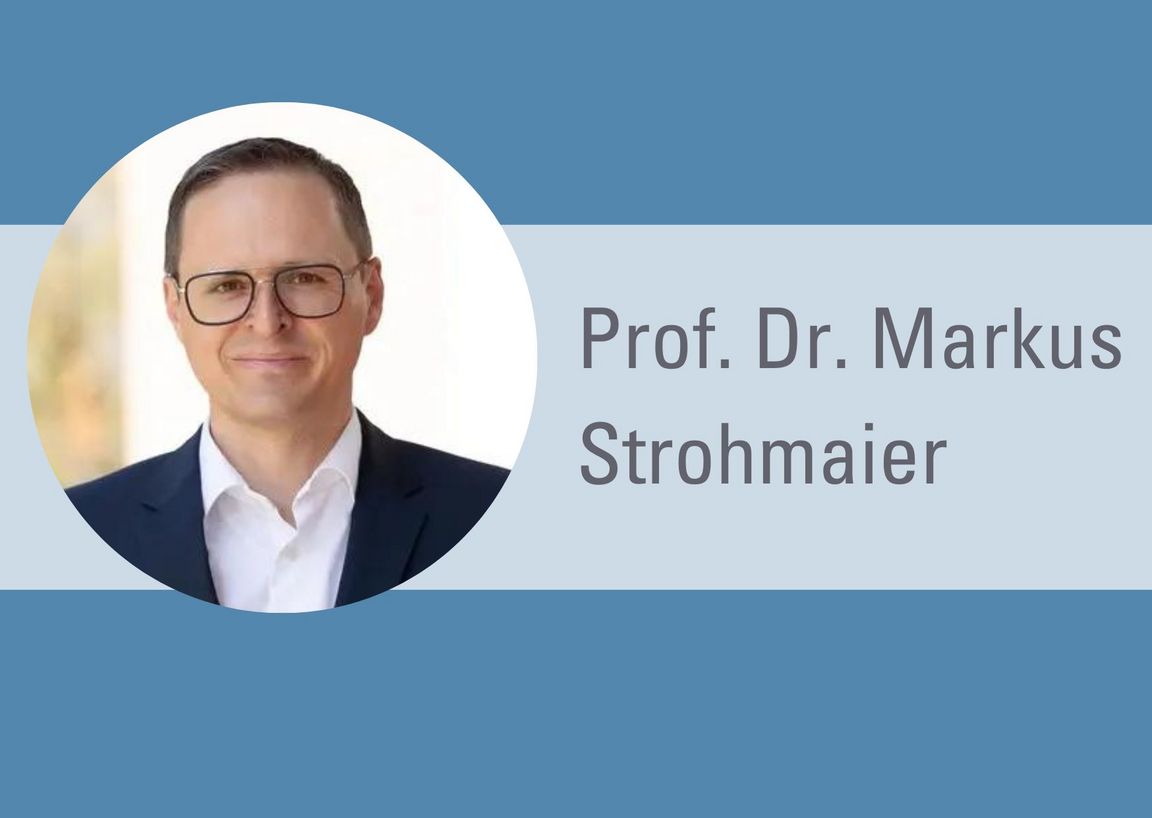
Prof. Dr. Markus Strohmaier
Prof. Dr. Markus Strohmaier holds the Chair of Data Science in the Economic and Social Sciences at the University of Mannheim. He also serves as Scientific Coordinator for Digital Behavioral Data at GESIS – Leibniz Institute for the Social Sciences and is an External Faculty Member at the Complexity Science Hub Vienna. From 2013 to 2017, he was Professor of Web Science at the University of Koblenz-Landau and the founding director of the Computational Social Science department at GESIS.
Between 2017 and 2021, he held the Chair of Computational Social Science and Humanities at RWTH Aachen University. Prior to that, he was a Postdoctoral Fellow at the University of Toronto (Canada), Assistant Professor at Graz University of Technology (Austria), Visiting Scientist at Xerox PARC (USA), and Visiting Assistant Professor at Stanford University (USA). From 2018 to 2022, he served as Editor-in-Chief of EPJ Data Science and co-founded the Computational Social Science section of the German Informatics Society.
Prof. Strohmaier’s research focuses on the development and application of computational methods to address challenges at the intersection of computer science, economics, and the social sciences.
Registration and Course Fees
- Please fill in the registration form and send it via email to ee@mannheim-business-school.com.
- The regular course fee is €3,240. Secure the early-bird discount of €2,950.
- Alumni and participants at Mannheim Business School, their spouses and co-habiting partners, and alumni, staff and participants of the University of Mannheim receive a 20% discount on this program.
- Discount of €1,000 on the degree program if you decide to study the Mannheim Master in Management Analytics & AI after doing the Artificial Intelligence (AI) Technology Strategy Days.
- Good to know: Tax offices usually recognize costs for your further education if they are job-related. Depending on your tax status in Germany, you may claim up to 50% of the tuition fee and related travel expenses on your annual tax return. Outside of Germany, please check details with a tax advisor in your country of residence. Please note: Each federal state in Germany has regulations on educational leave. Check here to see which regulations apply in your federal state and get in touch with us to discuss your individual situation.
Contact Person

Downloads
- Registration Form AI Technology Strategy Days
- Brochure AI Technology Strategy Days
MANNHEIM BUSINESS SCHOOL (MBS)
Located in the heart of the German and European economy, Mannheim Business School (MBS), the umbrella organization for management education at the University of Mannheim, is considered to be one of the leading institutions of its kind in Germany and is continuously ranked as Germany’s #1.


MBS MERCHANDISE SHOP