
Mannheim Master in Management Analytics & AI (Full-Time)
Photo: Konstantin Postumitenko /canva
You are here: Programs & Courses » Master's Programs » Mannheim Master in Management Analytics & AI (Full-Time)
This Page
Turn Your Bachelor's Degree Into a Career in Analytics and AI
You have your bachelor’s degree – now turn it into a career with impact. Organisations across every industry need people who can turn data and AI into better business decisions. Whether your goal is consulting, a role at the intersection of business and technology, or a career launch in the European job market, the question is the same: how do you build the expertise and experience employers are looking for?
The Mannheim Master in Management Analytics & AI (Full-Time) gives you the answer in 15 intensive months. This on-campus Master of Science combines management, analytics and AI – no prior work experience or coding background required. Gain practical experience through a six-month internship with a partner company, solve real-world challenges in an analytics capstone project, and graduate with a University of Mannheim degree. For students from outside the EU, Germany’s 18-month post-study visa offers valuable time to start their career in one of Europe’s leading economies.
Key Facts *

Program Start
August 2027

Program Duration
15 months, including a 6-months internship

Program Structure
Full-time, on campus

Degree
M.Sc., awarded by the University of Mannheim
120 ECTS

Language
English

Tuition Fee
Introductory rate: €29,000 (Full fee: €32,000),
Scholarship round: Reduction of up to 35%,
University of Mannheim Alumni Rate: €15,000

Application Deadlines
First round: March 15, 2027,
Second round and University of Mannheim Bachelors: May 30, 2027.

Post-Study work Options
Non-EU/EEA graduates can stay in Germany up to 18 months after graduation on a job-search residence permit
* All information is subject to approval by the university committees. Therefore, changes to study design and content as well as admission requirements are still possible.
Upcoming Information Events
Key Benefits
A structured path from your bachelor's degree into your first analytics or business role – no coding background required.
Career and personal growth support, during the program and after graduation.
A six-month internship, synchronized with your coursework, for a fast track into the job market.
A ten-week capstone project in a team, tackling a real-world business challenge for a company.
A curriculum proven over six years in our Part-Time Mannheim Master in Management Analytics & AI.
Study the leading program in its field in Germany and global #38 (QS Business Master’s Rankings 2027).
Direct access to the Mannheim Business School Network from day one.
Program Structure: Your Journey
The program runs for 15 months, in four phases – almost entirely face-to-face on campus. You work in Multi-Competence Teams (MCTs) on group projects throughout, and become part of the Mannheim Experience: the network and community that come with studying in person, not online.
 | Foundations (Course Phase 1, August – October) You build the core toolkit: data and technology foundations, Python programming, and the first strategic innovation modules. This phase is designed so you can work independently once your internship starts – not just support tasks. |
 | Internship – 6 months (November – April) Your internship sits at the center of the program. Through MBS Employer Matching, you are placed with a partner company for six months, applying what you learned in Course Phase 1 to real business problems. By the time you return to campus, you already have applied, resume-ready experience. |
 | Core Analytics (Course Phase 2, May – June) Back on campus, you go deeper: advanced analytics and AI methods, decision-making under uncertainty, and the remaining modules from all four curriculum pillars.
|
 | Applied Practice: Business Analytics Master Project (BAMP) July – September Your capstone project. Working with a partner company and in a team of classmates, you apply the full toolkit from the program to a real business problem, from framing the question to presenting a data-driven recommendation. |
Program Overview
Pivotal Elements of Your Study Experience
Gain practical experience through a six-month internship with a partner company, working on transformational projects at the intersection of business strategy, stakeholder management, and technology.
Mannheim Business School is building a growing network of corporate partners across a range of industries for this program, including Diehl Defence, SET Management Consulting, Würth, and Zeiss – with new partners joining as the program grows.
Internships are offered in German or English. If you are not already fluent in German: German is not required for admission, but we strongly encourage you to start a language course before the program begins – it will help during your internship, and when applying for certain roles later on.
Team up with fellow students to apply everything you've learned in one comprehensive capstone: solve a real business challenge with a company sponsor, or build a business plan for a new product or venture.
Multi-Competence Team (MCT) coaching sessions ensure that every team member gets to contribute their views and experiences, and is treated with courtesy and respect. Working in your MCT itself will hone your intercultural, communication and leadership skills, and stimulate your ability and willingness to reflect on perspectives vastly different from your own. The very success of your Master's thesis hinges on you having a high-performance team.
Apply your skills to a real social-impact project, partnering with a nonprofit or public-sector organization.
Alongside the academic courses, a structured personal and professional development curriculum runs throughout the program. Career bootcamps and alumni talks prepare you for the job market, innovation and management workshops sharpen how you think and lead, and Multi-Competence Team coachings foster collaboration, communication and problem-solving skills, increase your capability for self-reflection and open your mindset for different perspectives.
From day one of your studies, you become part of a global network of business professionals and enjoy access to a wide range of events and networking opportunities. Lifelong learning offers, corporate contacts, a digital directory, events with Mannheimers across programs and cohorts, job offers and career development resources are yours to use for your personal and professional development during and after your degree.
Academic Courses

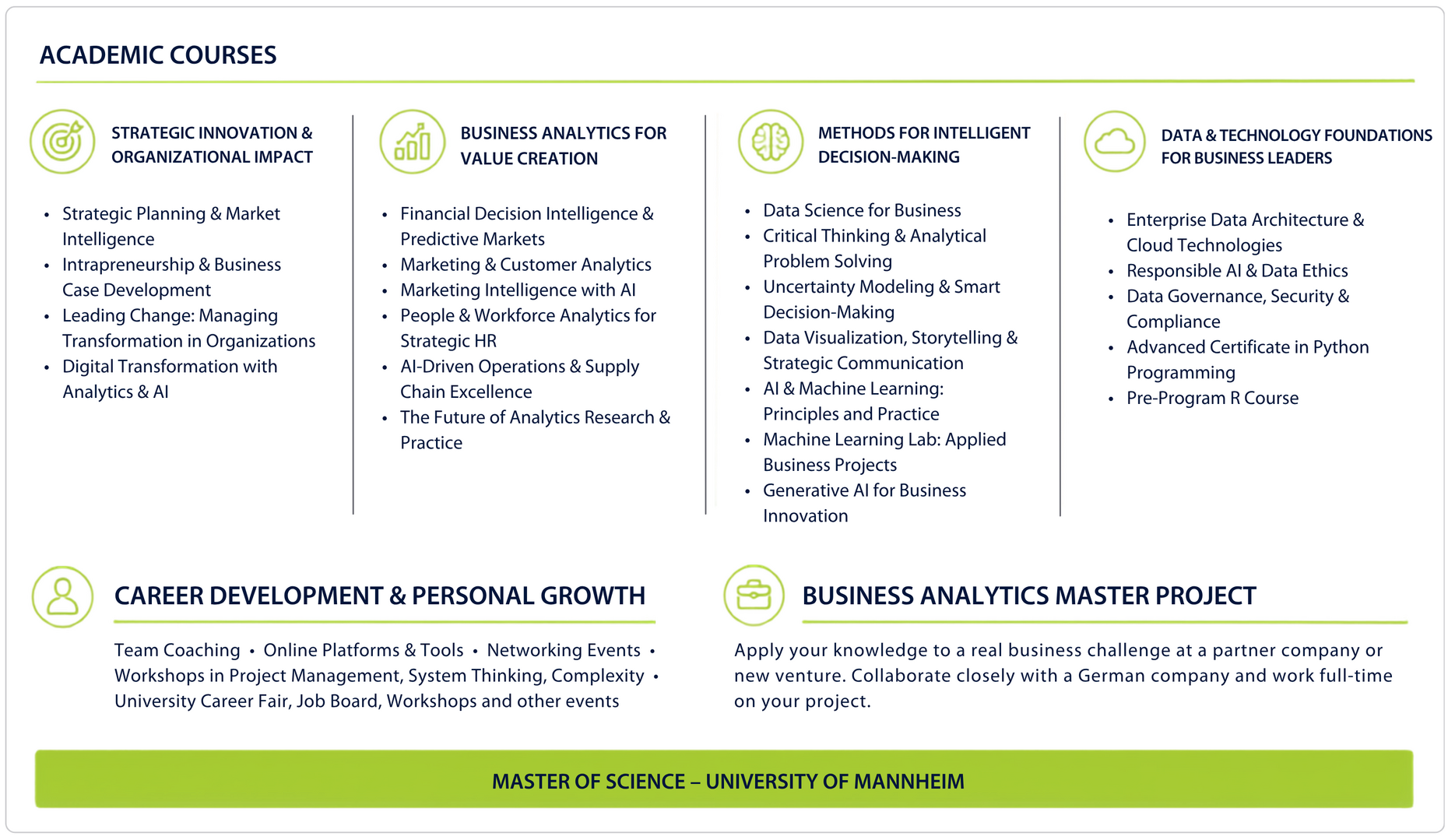
Build the strategic, analytical and technical capabilities to lead in a data- and AI-driven economy. The curriculum brings together business strategy, applied analytics, machine learning and responsible technology leadership, equipping you to identify opportunities, make confident decisions under uncertainty, and turn data into measurable organisational impact. Hands-on courses, applied labs and programming courses in Python and R ensure that you do not just understand analytics and AI – you can put them to work on real business challenges.
Strategic Innovation & Organizational Impact
This pillar builds the strategic mindset future analytics leaders need: reading markets, driving change, and translating digital opportunity into organizational impact.
Markets rarely move in straight lines, and tomorrow's leaders need to plan for several possible futures at once. This course introduces foresight techniques and market-intelligence methods that help you spot emerging trends early, read competitive dynamics, and stress-test strategic options before committing to them. You'll leave with a practical toolkit for building resilience into any strategy, whether you're joining an established corporation or a fast-growing venture.
Learning Goals – in this course, participants:
- Use foresight methods to spot emerging trends and disruptions before competitors do
- Read competitive dynamics to sharpen strategic positioning
- Build multiple future scenarios to pressure-test decisions under uncertainty
- Translate foresight insights into a coherent long-term strategy
Great ideas only create value once someone turns them into a credible business case. This hands-on course trains you to think like an intrapreneur inside an existing organization: shaping a promising idea, quantifying its financial upside, and designing a roadmap that stakeholders will actually approve. Team exercises and live pitch sessions sharpen your ability to defend a proposal that is ambitious yet realistic.
Learning Goals – in this course, participants:
- Build business cases that connect a clear vision with measurable ROI
- Apply intrapreneurial thinking to drive innovation inside established organizations
- Balance bold ambition with operational feasibility in your proposals
- Pitch and defend business cases convincingly to different stakeholders
Strategy only matters if people actually follow through on it. This course gives you the frameworks and leadership tools to guide teams through transformation, overcome resistance, and keep people engaged when the ground is shifting beneath them. You'll practice the interpersonal side of change leadership – building trust and alignment – so that transformation efforts stick long after the initial announcement.
Learning Goals – in this course, participants:
- Apply established models and frameworks for managing organizational change
- Diagnose organizational readiness and identify likely sources of resistance
- Develop approaches for leading people through uncertainty
- Build the leadership habits that make transformation stick long-term
Every industry is being reshaped by data and AI, but turning that potential into real value takes more than adopting new tools. This course connects digital strategy with data-driven decision-making, showing you how to evaluate what AI adoption really means for an organization and how to design transformation roadmaps that hold up in practice – while keeping ethics and sustainability firmly in view.
Learning Goals – in this course, participants:
- Connect digital transformation strategy with practical analytics and AI capabilities
- Use data-driven insight to strengthen competitiveness and innovation
- Weigh the ethical and sustainability implications of AI adoption
- Design digital roadmaps that balance opportunity with business impact
Business Analytics for Value Creation
Here you apply analytics to the functions that create business value – finance, marketing, people, and operations – turning data into decisions that move the needle.
AI and machine learning are rewriting the rules of financial decision-making. This course shows you how to apply data-driven approaches to investment analysis, valuation, and risk modeling, and how predictive and algorithmic methods are changing forecasting. You'll come away with a working understanding of how modern finance teams use technology to make sharper, more resilient decisions in volatile markets.
Learning Goals – in this course, participants:
- Apply advanced analytics and AI to strengthen financial decision-making
- Build predictive models to support investment analysis and risk management
- Assess how predictive markets and algorithmic tools shape financial forecasts
- Factor sustainability and ethical considerations into AI-driven finance
Understanding what customers actually want – and predicting how they'll respond – is the foundation of every effective marketing strategy. This course introduces the analytical methods used to measure customer relationships, forecast responses to marketing actions, and estimate long-term customer value, so you can turn raw data into strategic marketing decisions with real business impact.
Learning Goals – in this course, participants:
- Analyze customer data to uncover preferences, behavior, and value drivers
- Apply analytical methods to measure and manage customer relationships
- Evaluate marketing effectiveness using predictive and response models
- Turn customer insight into concrete, actionable marketing decisions
Segmentation, personalization, and campaign optimization all look different in the age of AI. This course explores how AI-driven marketing intelligence systems enable sharper targeting and richer customer experiences, and challenges you to design and critically evaluate AI-enabled marketing strategies that balance performance with ethical responsibility.
Learning Goals – in this course, participants:
- Apply AI-driven methods for segmentation and personalization
- Optimize marketing campaigns using predictive and prescriptive analytics
- Assess the real business impact of AI-enabled marketing intelligence
- Navigate the ethical and data-privacy questions raised by AI in marketing
HR decisions are increasingly made with evidence, not intuition. This course equips you to analyze workforce trends, forecast talent needs, and build recruitment, retention, and performance strategies grounded in data – while learning to critically assess data quality so that people decisions rest on solid ground rather than tradition.
Learning Goals – in this course, participants:
- Use people analytics to surface workforce trends that inform HR decisions
- Apply predictive models to recruitment, retention, and performance
- Design evidence-based strategies for workforce planning
- Evaluate the ethical and cultural implications of people analytics
Modern supply chains run on data, automation, and AI-driven optimization. This course explores how organizations use advanced analytics to build efficient, resilient, and sustainable supply networks, giving you the tools to design AI-enabled operations strategies and evaluate digital solutions against both competitiveness and environmental responsibility.
Learning Goals – in this course, participants:
- Apply AI and analytics to optimize operations and supply chain performance
- Design data-driven strategies for efficiency, resilience, and sustainability
- Evaluate automation and digital tools across end-to-end processes
- Weigh risk management and sustainability in supply chain decisions
Methods for Intelligent Decision-Making
This pillar builds your core analytical toolkit – from data science and machine learning to critical thinking and storytelling – the methods that turn data into good decisions.
Data science now sits at the center of business performance, powering both operational and strategic decisions. This course introduces the core concepts, tools, and practices of data science from a managerial perspective, so you understand not just how models work but how organizations extract real monetary value from their data assets.
Learning Goals – in this course, participants:
- Apply core data science techniques to real business problems
- Translate analytical results into decisions non-technical stakeholders can act on
- Evaluate the performance and limitations of predictive models
- Build data science thinking into strategic decision-making
More data doesn't automatically mean better decisions – cognitive bias can distort even the most rigorous analysis. This course draws on the psychology of critical thinking to reveal the biases that quietly shape how data is collected, analyzed, and interpreted, and introduces proven debiasing techniques so you can reason more clearly and argue your conclusions more convincingly.
Learning Goals – in this course, participants:
- Reflect critically on your own analytical thinking and data-handling habits
- Recognize common cognitive biases that distort data analysis
- Judge the credibility and quality of external information and analyses
- Communicate your reasoning and results more persuasively
Few business decisions come with complete information. This course equips you with simulations, probabilistic modeling, and decision theory to analyze uncertainty systematically, helping you weigh risk against opportunity – and make sustainable choices – even when the full picture isn't available.
Learning Goals – in this course, participants:
- Apply probabilistic models and simulations to evaluate uncertainty
- Use decision theory to support complex business choices
- Assess risk-return trade-offs in uncertain environments
- Build uncertainty modeling into everyday strategic and operational decisions
The best analysis is worthless if nobody acts on it. This course trains you to turn complex analytical results into clear, persuasive narratives for different audiences, combining visualization, storytelling technique, and strategic framing so your data actually changes minds and drives decisions.
Learning Goals – in this course, participants:
- Turn complex data into compelling, decision-ready business stories
- Use visualization tools to communicate insight clearly
- Adapt analytical messages to different audiences and stakeholders
- Strengthen your strategic influence through clear communication
This course builds a solid foundation in machine learning – covering the core algorithms behind supervised and unsupervised methods and how they create business value. You'll get hands-on practice applying ML techniques to real problems while thinking critically about their ethical and sustainability implications.
Learning Goals – in this course, participants:
- Understand foundational AI and machine learning concepts and methods
- Apply supervised and unsupervised learning techniques to business data
- Evaluate model performance and interpretability
- Weigh ethical and sustainability considerations in ML applications
Theory becomes skill only through practice. This lab-based course has you work through complete, real-world machine learning projects – from data preparation to model building, validation, and deployment – while developing the teamwork and problem-solving habits that make ML projects succeed in a business setting.
Learning Goals – in this course, participants:
- Design and build ML models to address real business cases
- Manage the full ML pipeline, from raw data to working application
- Collaborate effectively within applied analytics project teams
- Translate technical ML solutions into strategic recommendations
Generative AI is opening entirely new avenues for creativity, automation, and productivity. This course explores how organizations use GenAI for content creation, customer engagement, process automation, and product design, and challenges you to design your own business use cases while weighing the opportunities and risks involved – including the fundamentals of effective prompt engineering.
Learning Goals – in this course, participants:
- Understand the principles and business applications of generative AI
- Explore how GenAI drives creativity, automation, and productivity gains
- Design business use cases that put GenAI to work for innovation
- Evaluate the ethical and organizational implications of GenAI adoption
- Apply prompt engineering techniques to real business problems
Data & Technology Foundations for Business Leaders
This pillar builds the technical literacy every data-driven leader needs – architecture, governance, ethics, and hands-on coding skills – so you can lead confidently at the intersection of business and technology.
Analytics and AI can only reach their potential on top of a well-designed data architecture. This course walks through the layers organizations need – from ingestion and storage to processing, access, and governance – the major architecture patterns such as data warehouses, lakes, and lakehouses, and how these concepts play out in real cloud environments through a hands-on exercise.
Learning Goals – in this course, participants:
- Understand the terminology and concepts behind enterprise data architecture
- Distinguish architecture layers, patterns, and data-modeling techniques in the cloud
- Judge which architectural choices fit which analytical or business needs
- Apply these concepts hands-on using an end-to-end cloud provider toolset
As AI becomes central to business strategy, leaders need to know how to use it responsibly. This course examines the ethical challenges that come with advancing AI – bias, explainability, harm, sustainability, and labor displacement – and builds your ability to make sound decisions and foster organizational awareness where innovation and ethics reinforce each other.
Learning Goals – in this course, participants:
- Understand the ethical challenges of AI, including bias and explainability
- Recognize the organizational trade-offs that come with AI innovation
- Make informed, responsible decisions about AI use in business
- Embed responsible AI practices into organizational strategy
Data is one of the most valuable assets a company holds – but only if it's managed responsibly. This course examines how organizations build the structures and controls that protect data privacy, cybersecurity, and legal compliance, including risk-management frameworks, breach response, and a practical overview of the EU regulatory landscape shaping analytics and AI.
Learning Goals – in this course, participants:
- Assess the core challenges of data governance
- Manage data security, privacy, and risk across complex organizations
- Embed governance and cybersecurity into business and analytics strategy
- Apply risk-management frameworks and incident-response procedures
- Understand how EU regulation shapes analytics and AI practice
Python is the leading language for data science, analytics, and AI – and no prior coding experience is required. This certificate builds your Python skills from the ground up, covering core concepts, data structures, and the libraries used every day in analytics, so you can write clean, efficient code and apply it to real business problems.
Learning Goals – in this course, participants:
- Understand core programming concepts and Python syntax
- Apply Python libraries to analyze and visualize data
- Write clean, reusable code for business applications
- Build the foundation you'll need for advanced AI and analytics courses
Career & Professional Development

Build competencies that carry beyond the classroom: From self-awareness, strategic and systems thinking, to collaboration and team effectiveness.
Practical, hands-on sessions covering hiring culture and recruitment processes, CV and LinkedIn optimization as well as networking.
Key Skills Developed: Career Management, Self-Presentation, Networking, Employability
Workshops on systems thinking, complexity, and project management.
Key Skills Developed: Strategic Thinking, Problem Solving, Project Planning,Collaboration
Two structured coaching sessions with your Multi-Competence Team, designed to strengthen how your team works together under real project pressure.
Key Skills Developed: Teamwork & Collaboration, Leadership & Followership, Communication & Feedback, Problem Solving, Stakeholder Management, Project Management, Conflict Resolution, Decision-Making Under Uncertainty, Cross-Functional Collaboration, Self-Awareness & Reflection
Networking events throughout the program, access to University Career Fair and corporate partner events.
Career Outcomes

Graduates are prepared for roles that combine business judgment with data and AI skills, for example in Consulting, Analytics, Business & Innovation, or Transformation roles:
- People Analytics Manager
- Business Analytics Consultant
- Change Management Consultant
- Data Strategy Analyst
- Customer Intelligence & CRM Manager
- Marketing Analytics Manager
- Product Manager
- Business Development Manager
- Talent Analytics Lead
- Responsible AI & Governance Lead
- Transformation Manager
Application & Admission
Learning with and from one another is a central component of the Mannheim Master in Management Analytics & AI (Full-Time). Thus, we value candidates, who enjoy enriching the group by sharing their competences, experiences and commitment. Do you fit this description? Find the formal criteria and application deadlines listed below:
Requirements
- First academic degree (bachelor's or equivalent)
- Fluency in English
- Strong analytical mindset
- Motivation to build an international career
- APS if your first degree is from India, Vietnam, or China – unless you have since completed a further degree in another country
- No prior work experience required
- No programming experience required
- No GMAT required
- Please fill out the Self-Assessment of Academic Background Form Provided below
Application Rounds & Tuition Fees
We offer the Mannheim Master in Management Analytics & AI (Full-Time) at an introductory fee of €29,000.
- 1st Scholarship Round: March 15, 2027 (up to 35% discount)
- 2nd Scholarship Round: May 30, 2027 (up to 15% discount)
- 3rd Scholarship Round: June 20, 2027 (~10% discount)*
- Mannheim Alumni Round: May 30, 2027 (>53%: Alumn Fee of 15.000€)
Final application deadlines:
- for candidates with APS required: March 30, 2027
- for candidates with Visa required: April 30, 2027
- for candidates with no Visa and/or APS required: May 30, 2027
Scholarships
We build our cohorts with people who bring something different to the table. That's why we offer partial scholarships across a range of categories – and why you can also make a case for one we have not thought of. If none of the categories describes you, tell us about it under Your Own Category.
How it works
During your online application, select up to three categories that fit you and answer two short questions. Our admissions committee reviews your scholarship case alongside your application, so there is no separate process and no extra deadline to track. All applicants apply for partial merit-based scholarships (up to 35%).
MBS Master's Scholarship Categories
- Women in Analytics & AI
- Academic Excellence
- International Experience
- Language & Cultural Fluency
- Social Impact & Community
- Entrepreneurship & Innovation
- Athletic Achievement
- Your Own Category
Essay Questions
1. What will you bring to your class?
Tell us about the perspective, experience or skills you'd add to a group of 25–30 people from different countries and academic backgrounds. This doesn't need to be professional experience – what shaped the way you think and work counts just as much. (max. 250 words)
2. How do you want to contribute to the Mannheim Business School community?
Our community doesn't end at graduation. Tell us how you'd like to get involved, both during your studies and as an alumna or alumnus afterwards. (max. 250 words)
Loans for International Students
For a general overview of possible support options for your acacemic career, career start bw might be a useful resource.
If personal savings won't cover the full tuition, Prodigy Finance offers community-funded loans for international students at selected business schools, including Mannheim. For terms and the application process, visit the Prodigy Finance website..
The German income tax system may allow participants of a master's program considerable tax benefits due to tuition fees.
Prodigy Finance Ltd is incorporated in the United Kingdom (Company Number 05912562) and registered with the Office of the Information Commissioner (Reg. No. Z9851854). Prodigy Finance Ltd is authorized and regulated by the Financial Conduct Authority, and entered on the Financial Services Register under firm registration number 612713. Prodigy’s registered address is Palladium House, 1-4 Argyll Street, London, W1F 7LD.
Checklist for a Complete Application
- Current CV
- Digital photo
- Proof of English language proficiency
- Certificate of first degree
- Application video
- Self-Assessment of Academic Background Form
- Receipt of application fee (€99, non-refundable)
- APS for applicants with a first degree from China, India and Vietnam

Proof of English Language Proficiency
Accepted English language certificates:
- TOEFL iBT (Test of English as a Foreign Language – Internet Based Test) with a score of at least 85 points (Please send your scores directly to Mannheim Business School: 8860)
- IELTS (International English Language Testing System) – Academic Test with a band score of at least 6.5
- TOEIC (Test of English for International Communication) with a score of at least 845 points
- telc (The European Language Certificate) – English University with at least level B2
- Cambridge Certificate in Advanced English (C1 Advanced) with a minimum of Level C
- Cambridge Certificate of Proficiency in English (C2 Proficiency) with a minimum of Level C
- Cambridge English: First (B2 First) with a minimum of Level C
- Cambridge English: Business Certificate (BEC) with a minimum of Level B2
The English exam results must not be more than 2 years old when the program starts.
You do not need to submit an English test result, if
- you have successfully completed a minimum two-year degree with English as a language of instruction for at least half of all sessions and exams, or
- a university entrance qualification acquired in an English-speaking school system.
Arrange an online consulting session with our Admissions Manager
If you are wondering whether your profile matches our criteria, please get in touch with our Admissions Manager Katja Gold, who will then set up an appointment with you for a preliminary CV check.
Contact Persons

Photo: Sarah Haehnle
Katja Gold
Admissions Manager Mannheim Master in Management Analytics & AI (Full-Time)

Photo: Sarah Haehnle
Cathérine Erbach
Admissions Coordinator Mannheim Master in Management Analytics & AI (Full-Time)
Downloads
- Mannheim Master in Management Analytics & AI (Full-Time) Self-Assessment of Academic Background
MANNHEIM BUSINESS SCHOOL (MBS)
Located in the heart of the German and European economy, Mannheim Business School (MBS), the umbrella organization for management education at the University of Mannheim, is considered to be one of the leading institutions of its kind in Germany and is continuously ranked as Germany’s #1.


MBS MERCHANDISE SHOP