
Program Structure and Curriculum
You are here: Programs & Courses » Master's Programs » Mannheim Master in Management Analytics & AI (Part-Time) » Program Structure and Curriculum
Shape the Digital Transformation with Business Analytics Skills
The Mannheim Master in Management Analytics & AI is designed to equip you with advanced skills at the intersection of management and business analytics, enabling you to turn data into actionable strategic insights for your organization. Through a thoughtfully structured curriculum that combines rigorous academic content with practical application, you will deepen your understanding of analytical methods while strengthening your leadership and decision-making capabilities. The program’s flexible format allows you to balance your professional responsibilities with a comprehensive learning experience that prepares you to drive data-informed transformation across functions and industries.
An Overview of the Program Structure
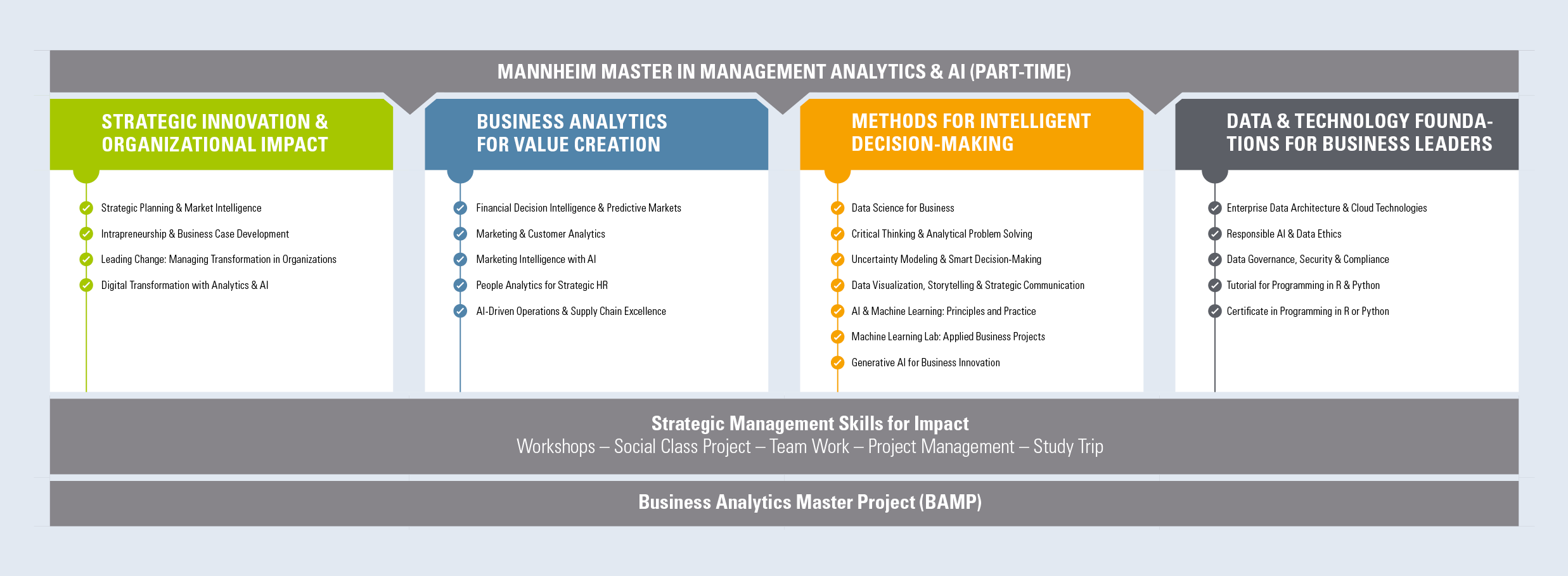
The Mannheim Master in Management Analytics & AI is organized in lecture weeks with modules that build on each other over a period of 24 months. (Click to enlarge the chart)
Build critical thinking and programming skills in R and Python. No prior coding experience is required.
Team up with fellow students to apply everything you've learned in one comprehensive capstone: solve a real business challenge with a company sponsor, or build a business plan for a new product or venture.
Real management skills, built through real team experience:
- Team Building – get to know your classmates and learn how to work together effectively
- MCT Coaching – two dedicated coaching sessions supporting you through the Business Analytics Master Project
- Change Management – learn how organizations successfully navigate and implement change in a fast-moving world
- Project Management Workshop – a one-day intensive on managing analytics and AI projects in practice, from messy data to shifting priorities and multiple stakeholders
- Systems Thinking & Complexity – sharpen your ability to think through complex problems involving AI, data, and teamwork, and make better decisions under uncertainty
Broaden your horizons on a study trip with your peers. You will visit a partner business school in a major European business hub and attend a mandatory course (accommodation included).
Apply your skills to a real social-impact project, partnering with a nonprofit or public-sector organization.
Strategic Innovation & Organizational Impact
In rapidly changing business environments, organizations must anticipate disruptions and prepare for multiple possible futures. This course provides participants with the concepts and tools of strategic foresight and market intelligence to identify emerging trends, analyze competitive dynamics, and explore alternative scenarios. By combining structured foresight methods with rigorous market analysis, participants will learn to strengthen organizational resilience and shape long-term competitive advantage.
Learning Goals – In this course, participants...
- Apply foresight methods to identify and evaluate emerging trends and disruptions.
- Analyze competitive dynamics to strengthen strategic positioning.
- Design future scenarios to support robust decision-making under uncertainty.
- Integrate foresight insights into strategy formulation for sustainable growth.
Organizations increasingly rely on entrepreneurial thinking from within a company to drive innovation and growth. This intensive, practice-oriented course empowers participants to act as intrapreneurs by turning promising ideas into actionable business cases. Participants will learn to connect creativity with strategic fit, quantify financial returns, and design credible execution roadmaps. Through team-based exercises and pitching sessions, participants will refine their ability to communicate and defend proposals that balance ambition with feasibility..
Learning Goals – In this course, participants...
- Develop persuasive business cases that connect vision, ROI, and execution.
- Apply intrapreneurial approaches to foster innovation within established organizations.
- Balance strategic ambition with operational feasibility in business case design.
- Communicate and pitch business cases effectively to diverse stakeholders.
Successful organizations are defined not only by their strategy but by their ability to adapt and transform. This course equips participants with the theories, tools, and leadership skills required to manage change initiatives in complex organizational settings. Participants will explore change management frameworks, learn to overcome resistance, and practice approaches to engage employees and stakeholders. Emphasis is placed on the leader’s role in fostering trust, resilience, and alignment to ensure that transformation efforts deliver lasting results.
Learning Goals – In this course, participants ...
- Understand key models and frameworks of organizational change management.
- Assess organizational readiness and identify barriers to change.
- Develop strategies to lead people through uncertainty and resistance.
- Build leadership skills to sustain long-term transformation.
Digital transformation is reshaping industries, driven by advances in analytics and artificial intelligence. This course examines how organizations can leverage digital tools to create value, enhance decision-making, and achieve sustainable growth. Participants will learn to connect digital strategies with data-driven insights, evaluate the organizational implications of AI adoption, and design transformation roadmaps. The course balances technical understanding with strategic and ethical considerations, preparing participants to lead data-enabled innovation responsibly.
Learning Goals – In this course, participants ...
- Connect digital transformation strategies with analytics and AI capabilities.
- Apply data-driven insights to enhance competitiveness and innovation.
- Evaluate ethical and sustainability considerations in deploying AI solutions.
- Design digital roadmaps that balance technological opportunity with business impact.
Business Analytics for Value Creation
The financial sector is undergoing a profound transformation through advanced analytics, machine learning, and AI-driven decision systems. This course equips participants with the skills to apply data-driven approaches in financial decision-making, investment analysis, and risk modeling. By exploring predictive markets, algorithmic forecasting, and AI-enabled valuation methods, participants will learn to leverage technology for superior financial insights and resilient strategies in dynamic markets.
Learning Goals – In this course, participants...
- Apply advanced analytics and AI to enhance financial decision-making.
- Develop predictive models for investment analysis and risk management.
- Assess the role of predictive markets in shaping financial forecasts.
- Integrate sustainability and ethical considerations into AI-driven finance.
Understanding customer preferences and behaviors is essential for effective marketing strategies. This course introduces participants to customer and market analytics, focusing on methods to measure and manage customer relationships, predict responses to marketing actions, and assess long-term customer value. Participants will learn to connect analytical insights with strategic marketing decisions to strengthen customer engagement and improve business performance.
Learning Goals – In this course, participants...
- Analyze customer data to understand preferences, behaviors, and value creation.
- Apply analytical methods to measure and manage customer relationships.
- Evaluate marketing effectiveness through predictive and response models.
- Translate customer and market insights into actionable strategic decisions.
AI is reshaping how organizations approach segmentation, personalization, and campaign optimization. This course explores AI-driven marketing intelligence systems that enable smarter targeting, enhanced customer experiences, and improved return on marketing investments. Participants will learn to design, implement, and critically evaluate AI-enabled marketing strategies that balance innovation, performance, and ethical responsibility.
Learning Goals – In this course, participants...
- Apply AI-driven methods for market segmentation and customer personalization.
- Optimize marketing campaigns using predictive and prescriptive analytics.
- Assess the business impact of AI-enabled marketing intelligence systems.
- Address ethical and data privacy considerations in AI-driven marketing.
People analytics is transforming human resource management into a strategic, data-driven discipline. This course equips participants with tools to analyze workforce trends, predict talent needs, and design HR strategies grounded in evidence-based management. Emphasis is placed on predictive analytics for recruitment, retention, and performance management, as well as the role of analytics in fostering workforce engagement, diversity, and long-term organizational resilience. Participants will learn to critically evaluate data quality, research findings, and analytical approaches to ensure HR decisions are supported by robust evidence rather than intuition or tradition.
Learning Goals – In this course, participants...
- Use people analytics to uncover trends and inform HR decisions.
- Apply predictive models to recruitment, retention, and performance outcomes.
- Design evidence-based strategies for workforce planning and development.
- Integrate evidence-based management principles into HR practice.
- Evaluate ethical, cultural, and sustainability implications of people analytics.
Operations and supply chains are increasingly shaped by AI, automation, and data-driven optimization. This course explores how organizations can leverage advanced analytics to achieve efficiency, resilience, and sustainability across global supply networks. Participants will learn to design AI-enabled operations strategies, optimize end-to-end processes, and evaluate digital solutions that enhance competitiveness while meeting environmental and social responsibilities.
Learning Goals – In this course, participants...
- Apply AI and analytics to optimize operations and supply chain performance.
- Design data-driven strategies for efficiency, resilience, and sustainability.
- Evaluate automation and digital solutions for end-to-end process excellence.
- Integrate risk management and sustainability considerations into supply chain decisions
Methods for Intelligent Decision-Making
Data science has become a cornerstone of modern business performance. This course “Data Science for Business” is designed to introduce you to key concepts, tools and practices of data science from a managerial perspective. Data is no longer used in companies only for operational decisions, but also for strategic decisions in all areas. Furthermore, data is the catalyst for innovation and productivity. However, the value of data assets comes from how it is used within an organization, which determines how important it is, and ultimately what monetary value can be determined.
Learning Goals – In this course, participants...
- Apply core data science techniques to real-world business problems.
- Translate analytical results into actionable business insights.
- Evaluate the performance and limitations of predictive models.
- Integrate data science into strategic decision-making processes
The ubiquity of information and large amounts of data nowadays requires the increased ability to analyze and interpret them in a reflective and critical manner. Moreover, any form of data collection, for example the use of machine learning algorithms, is inherently dependent on the impartiality of the data scientist. This course is designed to sensitize you to how cognitive biases - independent of the intentions of the data scientist - can impair critical thinking when dealing with data. The course draws on the psychology of critical thinking and explains the most common forms of cognitive biases. It also shows the implications for the collection, analysis and interpretation of data by analyzing a variety of examples from everyday management, the media or scientific publications. Finally, the course explains which "debiasing" techniques have proven to be effective in improving the quality of thinking and decision-making and how effective and undistorted reasoning can be used when dealing with data.
The aim of the course is to provide you with essential thought-provoking impulses for a critical and responsible approach to the collection, analysis and interpretation of data.To this end, the course provides the most important concepts and tools regarding formal (why is something wrong and how to recognize it) and psychological aspects of critical thinking (why do we tend to draw wrong conclusions and how to avoid them):
- Fundamentals of the psychology of critical thinking
- Overview of the most common cognitive biases in data analytics
- Sensitivity for statistical pitfalls in data analysis and the responsible handling of big data and machine learning algorithms
- Overview of proven strategies to neutralize or minimize the negative effects of cognitive bias
- Tools to improve your own argumentation and presentation of results
Learning Goals – In this course, participants...
- will be able to reflect critically on your own analytical thinking and data handling
- to assess external information and analyses with regard to their credibility and quality
- to communicate more effectively in your own argumentation and presentation of results
Business leaders often make decisions under conditions of uncertainty, risk, and incomplete information. This course equips participants with tools such as simulations, probabilistic modeling, and decision theory to analyze uncertainty and improve the quality of strategic choices. Emphasis is placed on balancing risk, opportunity, and sustainability in complex decision contexts.
Learning Goals – In this course, participants...
- Apply probabilistic models and simulations to evaluate uncertainty.
- Use decision theory to support complex business choices.
- Assess risk-return trade-offs in uncertain business environments.
- Integrate uncertainty modeling into strategic and operational decisions.
Data alone does not drive change—compelling communication does. This course trains participants to translate complex analytical results into clear, persuasive narratives tailored to diverse stakeholders. Through the use of visualization, storytelling techniques, and strategic framing, participants will learn to create impact by bridging the gap between data and decision-making.
Learning Goals – In this course, participants...
- Transform complex data into compelling business stories.
- Use visualization tools to communicate insights effectively.
- Tailor analytical messages to diverse audiences and stakeholders.
- Enhance strategic influence through clear and impactful communication.
AI and machine learning are transforming how businesses create value. This course provides a foundation in machine learning principles, algorithms, and practical applications, with a focus on supervised and unsupervised methods. Participants will gain hands-on experience applying ML techniques to solve business problems while considering ethical and sustainability implications.
Learning Goals – In this course, participants...
- Understand foundational AI and machine learning concepts and methods.
- Apply supervised and unsupervised learning techniques to business data.
- Evaluate model performance and interpretability.
- Assess ethical and sustainability considerations in ML applications
Building on foundational knowledge, this lab-based course provides hands-on experience in applying machine learning to real-world business challenges. Participants will work on end-to-end projects, including data preparation, model building, validation, and application. The course emphasizes practical problem-solving, teamwork, and the ability to deliver actionable business solutions through ML.
Learning Goals – In this course, participants...
- Design and implement ML models to address real-world business cases.
- Manage the end-to-end ML pipeline from data preparation to application.
- Collaborate effectively on applied analytics projects.
- Translate technical ML solutions into strategic business recommendations
Generative AI is redefining creativity, automation, and productivity across industries. This course explores how GenAI technologies enable new forms of business innovation, from content creation and customer engagement to process automation and product design. Participants will critically assess opportunities, risks, and ethical considerations of GenAI while experimenting with practical applications for enterprise transformation.
Learning Goals – In this course, participants...
- Understand the principles and applications of generative AI in business.
- Explore how GenAI enables creativity, automation, and productivity gains.
- Design business use cases that leverage GenAI for innovation.
- Critically evaluate ethical, social, and organizational implications of GenAI adoption.
- Understand Prompt Engineering techniques and deploy them for business innovation
Data & Technology Foundations for Business Leaders
To unlock the potential of analytics and artificial intelligence, organizations require a carefully designed enterprise data architecture. This course focuses on the design of enterprise data architectures and their realization in cloud environments. It covers (i) architectural layers and components (e.g., ingestion, storage, processing, access, and governance); (ii) principal architecture patterns (e.g., data warehouse, data lake, and lakehouse); (iii) data integration mechanisms (e.g., ETL/ELT, event-driven and batch/stream); (iv) data modeling for analytics (e.g., star, snowflake, data vault); and (v) governance (e.g., metadata management, lineage, access control, and data quality). A practical exercise demonstrates the real-world application of these concepts using an end-to-end suite from a cloud provider.
Learning Goals – In this course, participants...
- become familiar with the terminology and conceptual foundations used to describe enterprise data architectures.
- differentiate principal architecture layers, components, patterns, data integration mechanisms, and modeling techniques in cloud environments.
- evaluate the suitability of architectural choices for analytical and business requirements.
- apply these concepts in a practical exercise using an end-to-end suite of tools from a cloud provider.
As AI reshapes business strategy, leaders must define how their organizations use it responsibly. Participants will analyze and discuss ethical challenges associated with advances in AI, including bias, explainability, harm, sustainability, and labor displacement. Participants will learn how to make responsible decisions regarding AI use, and how to build organizational awareness that aligns technological innovation with ethical responsibility.
Learning Goals – In this course, participants...
- Understand ethical challenges associated with advances in AI from an organizational perspective, including bias, explainability, harm, sustainability, and labor displacement
- Recognize the resulting organizational trade-offs regarding innovation with AI
- Make informed and responsible decisions about the use of AI in business contexts
- Integrate responsible AI practices into organizational strategies.
Data has become one of the most valuable strategic assets for modern organizations, yet its responsible management demands rigorous governance. This course examines how firms establish the structures, controls, and practices that ensure data privacy, (cyber)security, and legal compliance. Participants will explore why effective data governance is fundamental to building trust, enabling lawful data use, and mitigating organizational risk. The course then addresses the challenges firms face in managing data security and protection and introduces frameworks for risk management and procedures for responses to data breaches. Moreover, participants will gain an overview of the EU regulatory environment shaping data compliance for analytics and artificial intelligence.
Learning Goals – In this course, participants...
- Assess the challenges of data governance
- Manage data security, privacy, and risk in complex organizations
- Integrate governance and (cyber)security into business and analytics strategies
- Apply risk management frameworks and response procedures to data security incidents
- Understand the EU regulatory environment and how it shapes organizational practices in analytics and artificial intelligence
R is a leading programming language for statistical computing, data analysis, and visualization. This certificate program introduces participants to the fundamentals of R programming, covering syntax, data structures, and key packages for analytics. Emphasis is placed on applying R to real-world business and research problems, enabling participants to prepare, analyze, and visualize data effectively.
Learning Goals – In this course, participants...
- Understand core programming concepts and R syntax.
- Apply R packages to manage, analyze, and visualize data.
- Write reproducible and efficient code for analytical tasks.
- Build a foundation for advanced courses in data science, machine learning, and quantitative modeling.
Python is the leading programming language for data science, analytics, and AI. This certificate program provides a practical introduction to Python programming, focusing on core concepts, data structures, and libraries for data analysis. Participants will gain hands-on experience writing clean, efficient code and applying Python to solve business-relevant analytical tasks.
Learning Goals – In this course, participants...
- Understand core programming concepts and Python syntax.
- Apply Python libraries to data analysis and visualization tasks.
- Write clean, efficient, and reusable code for business applications.
- Build a foundation for advanced courses in data science, AI, and analytics
Contact Person


MANNHEIM BUSINESS SCHOOL (MBS)
Located in the heart of the German and European economy, Mannheim Business School (MBS), the umbrella organization for management education at the University of Mannheim, is considered to be one of the leading institutions of its kind in Germany and is continuously ranked as Germany’s #1.


MBS MERCHANDISE SHOP